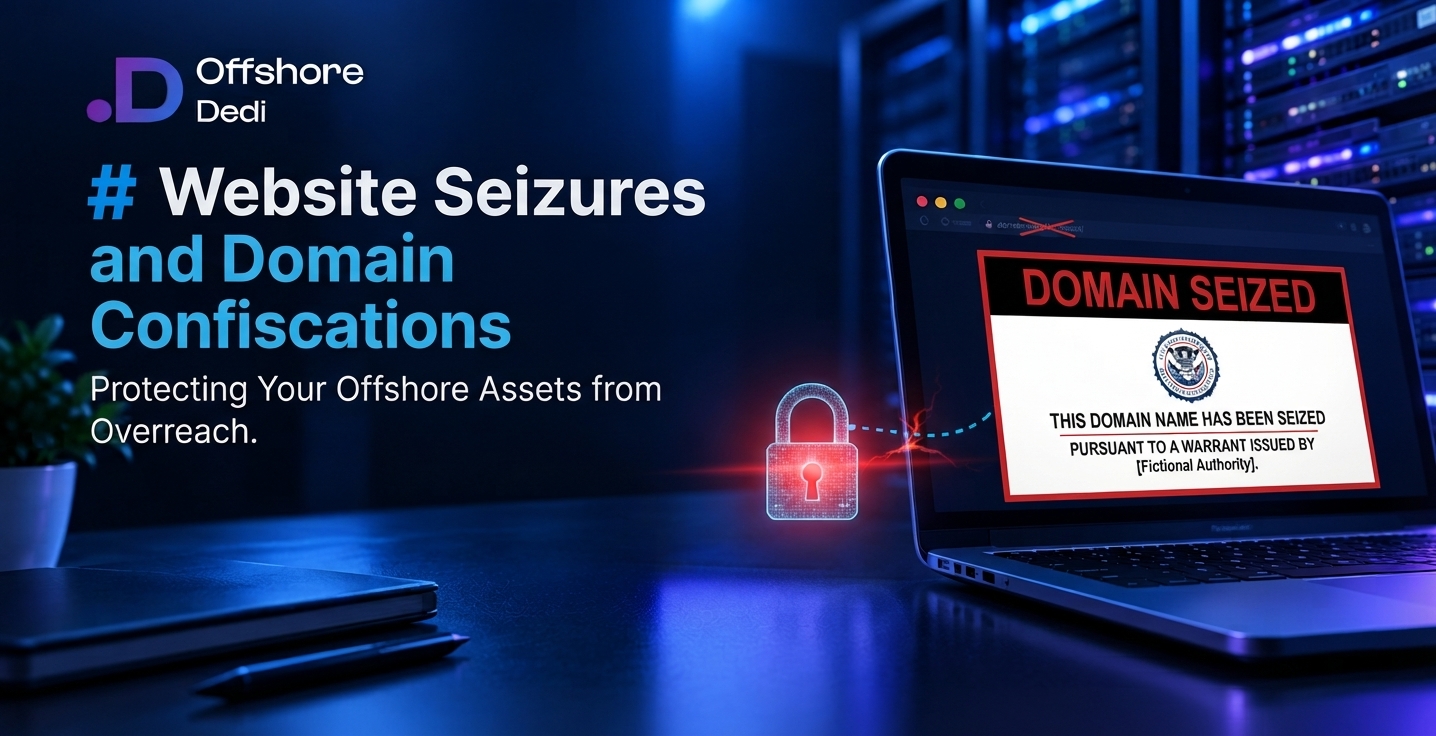
Website Seizures and Domain Confiscations: How They Work and What Website Owners Should Know
A website can become inaccessible for many different reasons, but a website seizure is different from an ordinary hosting suspension, domain expiration, or copyright takedown.
In a seizure, a government authority or law-enforcement agency takes legal control of a domain, server, website, or other digital property as part of an investigation or enforcement action. Depending on the circumstances and jurisdiction, authorities may obtain a court order or warrant that allows them to take control of a domain name, disable access to a website, or preserve digital evidence.
Domain seizures have been used in cases involving alleged criminal activity, fraud, intellectual-property violations, cybercrime, and other unlawful conduct. For example, the U.S. Department of Justice has announced court-authorized seizures of domains associated with alleged cyber operations and other unlawful activity.
However, it is important to distinguish a government seizure from other forms of online enforcement. A DMCA takedown request, for example, generally concerns access to allegedly infringing material and operates under a different legal framework from a government seizure of a domain.
What Is a Website Seizure?
A website seizure occurs when an authorized government or law-enforcement body takes control of, disables, or otherwise restricts a website or its associated digital assets under legal authority.
The exact mechanism varies according to the jurisdiction, the type of alleged violation, and the assets involved. A seizure may affect:
- The domain name
- The website’s hosting environment
- Specific servers or infrastructure
- Content stored on a server
- Online accounts or other digital assets
A seized domain may display an official notice instead of the original website. In previous U.S. enforcement actions, visitors to seized domains have been presented with seizure banners explaining that the domain is in government custody.
This is different from a temporary technical outage. A server going offline because of a hardware failure, network problem, unpaid hosting invoice, or cyberattack is not itself a website seizure.
Website Seizure vs. Domain Seizure vs. Takedown
These terms are sometimes used interchangeably, but they describe different actions.
| Action | What it generally means | Who may be involved |
|---|---|---|
| Domain seizure | Legal authorities take control of or restrict a domain name. | Law enforcement, courts, registrars and other infrastructure providers |
| Website/server seizure | Authorities take control of or secure servers, hosting infrastructure, or digital evidence. | Law enforcement, courts, hosting providers and investigators |
| Copyright takedown | A copyright owner submits a legally compliant notice concerning allegedly infringing material. | Copyright owner, service provider and designated agent |
| Hosting suspension | A hosting provider suspends service under its terms, an abuse process, or applicable law. | Hosting provider and customer |
The distinction matters because not every website that disappears has been “seized.” Under the U.S. DMCA framework, certain service providers can receive notices alleging copyright infringement, while domain seizure is a separate government enforcement mechanism. The U.S. Copyright Office explains that qualifying service providers may designate an agent to receive copyright-infringement notifications under Section 512.
The Role of Domain Registrars
A domain registrar is an important part of the domain-name infrastructure because it manages registration services for domain names. When a legally valid order or other authorized enforcement action applies to a domain, the registrar may be required to implement the relevant instruction.
Depending on the order and applicable rules, technical measures may include:
- Locking the domain against transfers
- Changing or suspending domain-related services
- Redirecting DNS resolution
- Placing the domain under government control
- Preventing the registered owner from modifying the domain
The precise procedure depends on the domain extension, registrar, jurisdiction, and legal authority involved. Website owners should therefore avoid assuming that every registrar follows exactly the same seizure procedure.
What Are the Legal Grounds for a Domain Seizure?
The legal grounds for seizing a website or domain depend heavily on the jurisdiction and the facts of the case.
In the United States, federal authorities have used domain seizures in criminal investigations involving alleged fraud, cybercrime, illicit marketplaces, intellectual-property offenses, and other unlawful activity. Recent Department of Justice announcements provide examples of domains being seized pursuant to court-authorized warrants.
Possible circumstances can include websites allegedly being used to:
- Facilitate criminal transactions
- Conduct or support cyberattacks
- Defraud users or organizations
- Distribute unlawfully obtained material
- Infringe intellectual-property rights on a significant scale
- Support other activities prohibited by applicable law
It is important not to treat every allegation of infringement as automatically resulting in a domain seizure. Different legal mechanisms exist for different types of disputes, and the available remedies depend on the relevant law and jurisdiction.
How Does Domain Confiscation Work?
A domain confiscation or seizure can involve several technical and legal stages. The exact process varies from case to case, but a simplified sequence may look like this:
- Investigation: Authorities investigate suspected unlawful activity and gather evidence.
- Legal authorization: Where required, investigators seek the appropriate warrant, court order, or other legal authority.
- Identification of digital assets: Authorities identify domains, servers, accounts, or other infrastructure connected with the investigation.
- Execution: Relevant parties implement the authorized seizure or restriction.
- Access is disrupted: The original website may become unavailable or may display an official seizure notice.
- Evidence may be preserved: Servers, files, logs, financial records, or other digital evidence may be secured depending on the investigation.
Actual enforcement can involve more than one organization. Domain registrars, hosting companies, infrastructure providers, law-enforcement agencies and other technical parties may each have different responsibilities.
What Happens to the Website After a Seizure?
The result depends on what authorities have seized and what the legal order permits.
A domain may stop resolving normally. Visitors may instead see an official seizure notice. In other circumstances, servers may be taken offline, content may be preserved as evidence, or specific infrastructure may be disabled.
A domain seizure does not necessarily mean that every technical component associated with a business has been permanently destroyed. The legal authority may be directed at a particular domain, server, account, or set of digital assets.
For that reason, website owners should distinguish between domain control, hosting control, and content control. These are related but technically separate layers of an online service.
What Happens to Website Owners?
A seizure can create significant operational consequences for a website owner.
The most immediate problem is usually loss of access to the affected website or domain. If the website generates leads, processes transactions, publishes content, or provides online services, the interruption can have a direct commercial impact.
There can also be consequences for:
- Customer communication
- Business email
- Brand visibility
- Search-engine traffic
- Advertising campaigns
- Customer trust
- Access to business records
- Third-party integrations
Reputational consequences can also be substantial. An official seizure notice can cause visitors to associate a domain with unlawful activity. However, the presence of a seizure notice does not by itself explain every factual or legal issue in the underlying case.
Why Backups Matter for Website Infrastructure
One of the most practical lessons for website owners is the importance of maintaining independent, reliable backups.
A backup cannot prevent a legally authorized seizure, nor should backups be viewed as a way to evade law enforcement. Their purpose is business continuity and recovery from ordinary technical failures, accidental deletion, ransomware, hardware failure, configuration mistakes, or other legitimate risks.
A sensible backup strategy can include:
- Regular automated backups
- Off-server backup storage
- Multiple backup versions
- Database backups
- Website-file backups
- Periodic restoration testing
- Restricted access to backup systems
Keeping backups in the same infrastructure as the production website can create a single point of failure. Independent backup storage can provide an additional layer of resilience for legitimate disaster-recovery purposes.
Preventive Measures for Website Owners
There is no technical configuration that can guarantee protection from a legally authorized government seizure. However, website operators can reduce legal, operational, and security risks by maintaining responsible infrastructure and compliance practices.
1. Understand the Laws That Apply to Your Website
Legal obligations can vary according to the country where the business operates, where customers are located, the type of content being published, and the services being provided.
For websites operating internationally, relying on a single country’s rules can create gaps in compliance. Businesses should obtain qualified legal advice where the applicable requirements are unclear.
2. Maintain Clear Terms and Policies
Websites that accept user-generated content should have clearly written terms of service, acceptable-use rules, privacy documentation, and content-moderation procedures appropriate to their business model.
Policies should not merely exist as boilerplate. They should reflect how the platform actually operates.
3. Monitor User-Generated Content
Platforms that allow users to upload files, publish posts, sell products, or share media may face additional legal and operational risks.
Reasonable moderation procedures can help identify potentially unlawful or abusive material before it becomes a larger problem.
4. Keep Business and Ownership Records Organized
Maintain accurate records for domains, hosting accounts, administrators, licenses, intellectual-property permissions, vendors, and important business transactions.
Good documentation can make it easier to understand and respond to disputes or compliance questions.
5. Strengthen Website Security
Security weaknesses can expose websites to compromise, unauthorized content uploads, account takeover, and abuse of infrastructure.
Basic security measures include:
- Keeping CMS software and plugins updated
- Using strong administrator authentication
- Enabling multi-factor authentication where available
- Limiting administrative access
- Monitoring suspicious login activity
- Maintaining tested backups
- Using appropriate network and server security controls
6. Choose Infrastructure Carefully
Hosting should be selected according to the website’s legitimate technical, security, availability, and compliance requirements.
Before choosing a provider, website owners should understand its acceptable-use policy, abuse procedures, backup options, security controls, data-center locations, support model, and applicable legal jurisdiction.
Can Offshore Hosting Prevent a Website Seizure?
It should not be presented as a guaranteed way to prevent a website seizure.
Hosting a server in another country can change the infrastructure’s physical location and may introduce different legal and jurisdictional considerations, but it does not make a website immune from legal action.
International investigations can involve cooperation between authorities in multiple countries. For example, recent U.S. enforcement actions have involved international investigative and law-enforcement cooperation.
For legitimate businesses, the more useful question is not how to make infrastructure “untouchable,” but how to select hosting that provides the appropriate combination of privacy, security, reliability, jurisdictional clarity, and operational control.
Website Seizure and Business Continuity
For businesses that depend heavily on a single domain or server, resilience should be considered as part of overall infrastructure planning.
A business-continuity strategy may include:
- Independent backups
- Documented recovery procedures
- Separate access credentials for critical systems
- Redundant infrastructure where appropriate
- Documented domain ownership
- Alternative communication channels
- Regular security reviews
These measures are primarily designed to protect against legitimate operational disruptions. They should not be confused with methods for circumventing a lawful seizure or enforcement action.
Frequently Asked Questions About Website Seizures
What does it mean when a website is seized?
It generally means an authorized government or law-enforcement authority has taken control of, restricted, or disabled a website, domain, server, or related digital asset as part of an enforcement action.
Can a domain name be seized?
Yes. Government authorities can seek legal authority to seize or take control of domain names in certain circumstances. The exact process depends on the jurisdiction and the applicable law.
Is a DMCA takedown the same as a domain seizure?
No. A DMCA takedown concerns a copyright-infringement notification and access to allegedly infringing material under the applicable copyright framework. A government domain seizure is a different type of legal enforcement action.
Can a hosting provider seize a website?
A hosting provider can generally suspend or terminate service under its contract, acceptable-use policy, or applicable law. That is not necessarily the same as a government seizure.
Does offshore hosting make a website immune from seizure?
No. It may affect where infrastructure is physically located and which jurisdictions are relevant, but it does not provide absolute immunity from legal action.
Can a seized domain be recovered?
Potential remedies depend on the legal authority involved, the jurisdiction, the facts of the case, and the applicable court or administrative process. A website owner facing an actual seizure should obtain advice from a qualified lawyer familiar with the relevant jurisdiction.
How can website owners reduce the risk of disruption?
Businesses can reduce operational risk through appropriate legal compliance, security controls, independent backups, documented recovery procedures, reliable infrastructure, and a clear understanding of their hosting and domain agreements.
Final Thoughts
Website and domain seizures are serious legal and technical events, but they should not be confused with routine hosting suspensions, website outages, or copyright takedown notices.
The most important distinction is between the legal authority behind an action and the technical mechanism used to enforce it. Registrars, hosting providers, infrastructure operators, and law-enforcement agencies can each play different roles depending on the circumstances.
For website owners, responsible infrastructure planning is the most practical approach. Maintaining strong security, independent backups, accurate records, appropriate policies, and a clear understanding of the jurisdictions affecting the business can improve resilience without relying on unrealistic claims of legal immunity.
Important: This article provides general information and is not legal advice. Laws and enforcement procedures vary by jurisdiction. If your domain, server, or website is subject to an actual legal order or seizure notice, consult a qualified attorney in the relevant jurisdiction.